What Is a Seamless Steel Pipe? Heavy Duty Cylinder Basics
A seamless steel pipe is a hollow steel section formed from a solid billet that is pierced and rolled without a longitudinal weld seam. In a heavy duty hydraulic cylinder, that pipe is not a commodity accessory. It becomes the barrel — the pressure vessel that has to contain hydraulic oil at high pressure while a piston and rod travel through it for the working life of the machine.
New buyers usually start with the visible parts of a cylinder: the piston rod, the seals, the mounting configuration. The barrel gets treated as a tube that simply needs to be the right size. That is where cost surprises begin. Wall thickness, steel grade, inner diameter tolerance, straightness and bore finish all originate in the pipe, and all of them determine whether a high-pressure heavy duty hydraulic cylinder holds pressure — or begins leaking oil after a few thousand cycles.
This explainer covers the material itself: what a seamless steel pipe is, how it is classified, which parameters matter inside a cylinder barrel, and how a pipe travels through a build sequence into a finished large bore heavy duty hydraulic cylinder. Shandong Tuoda Machinery Equipment Co., Ltd. (Tuoda Machinery) is a manufacturer based in Liaocheng, Shandong, China, producing carbon seamless steel tube, round bars and pressure cylinders, with exports to the EU, Asia and South America. Its own production flow — pipe deep processing, heat treatment, honing and custom cylinder assembly — is used below as a concrete reference for how the material is actually used.
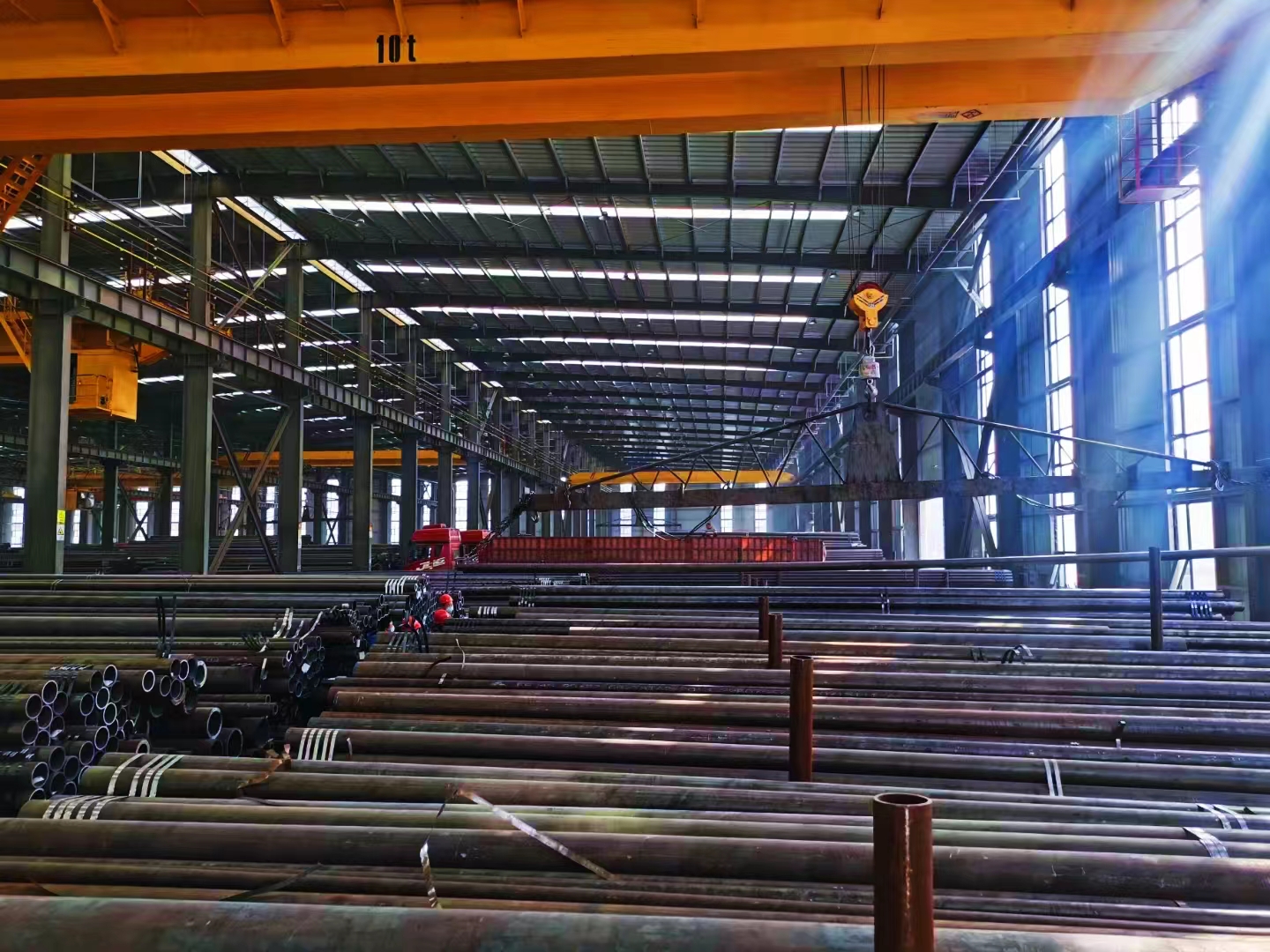
Seamless pipe is stored and traced before machining. The grade, wall thickness and heat number on each bundle follow the barrel through honing, welding and pressure testing.
The Barrel Is a Pressure Vessel: What Goes Wrong When Pipe Quality Is Marginal
Most heavy duty hydraulic cylinder failures that reach a maintenance team start at the bore surface or at a pressure boundary, not at the mounting flange. A bore that is out of round, tapered or too rough will not hold a seal film. A wall that is thinner than the drawing allows will deflect under load. A pipe with irregular wall thickness forces the machinist to remove more material to clean up the bore, which reduces the remaining wall — and the pressure rating with it.
The gap between standard and heavy duty construction is not cosmetic. Documented heavy duty cylinder capability extends to bores of 36 inches and above, strokes of 40 feet and beyond, and pressures up to 10,000 psi, and it is built around high-strength material, massive components and long-stroke, large-bore geometry. At those levels, a barrel is engineered, not selected from a catalogue size.
Two failure patterns recur in custom cylinder production. The first is insufficient output power — the cylinder is dimensionally correct but cannot deliver the force the application demands, usually because the barrel or rod dimensions were carried over from a lighter specification. The second is a bore condition problem that only appears after assembly. Tuoda Machinery controls both by combining auxiliary equipment, pressure testing and strict quality inspection before dispatch, and by re-confirming the quotation and application details with the buyer before production is released.
Industry Background: Why Pipe Specification Became a Cylinder Decision
Hydraulic cylinders are a large and growing equipment category. The global hydraulic cylinder market was valued at USD 17.34 billion in 2025 and is projected to reach USD 18.11 billion in 2026, according to Fortune Business Insights. Within that market, Asia Pacific held a 38.40% share in 2025, and double-acting cylinders accounted for a 70% share in 2024.
Those numbers matter to a pipe buyer for one reason: volume concentrates in a region where the supply chain is vertically integrated with steel production. Liaocheng in Shandong is a long-established cluster for seamless steel pipe, and manufacturers located there can source, process and machine pipe within a short physical distance. Tuoda Machinery operates in that cluster, covering steel pipe deep processing, steel heat treatment, custom hydraulic cylinder manufacturing and deep-hole drilling and boring machine production.
The practical consequence is that a cylinder factory no longer has to be a pure assembler. When the same facility that normalizes, hones and inspects the pipe also machines the cylinder, wall thickness, bore tolerance and seal geometry are decided together rather than negotiated across two suppliers.
Seamless Steel Pipe Defined for Cylinder Buyers
A seamless steel pipe begins as a solid steel billet. The billet is heated, pierced to create a hollow shell, then rolled and sized into a tube. Because the material is displaced from a solid form rather than bent from strip and joined, there is no longitudinal weld running the length of the pipe. After rolling, pipe may be supplied hot-rolled or further processed by cold drawing to achieve tighter dimensions and a better surface.
Tuoda Machinery supplies both hot-rolled and cold-drawn seamless pipe. For cylinder work, cold-drawn stock is commonly the input for bores that need to be bored, honed and held to a fine tolerance, while hot-rolled stock is used where the drawing calls for a coarser starting dimension that will be machined down.
At a glance. A seamless pipe has no longitudinal weld seam; it is formed from a pierced billet. Its value in a cylinder barrel is uniformity: consistent wall thickness around the circumference, a bore that can be honed to a repeatable finish, and a continuous pressure boundary. Those three properties — not the word “seamless” by itself — are what a buyer is actually paying for.
How Seamless Steel Pipe Is Classified
Seamless pipe is normally grouped by the service it is intended for. The three categories a cylinder buyer will encounter first are structural steel pipe, oil steel pipe and gas steel pipe. The category describes the intended duty and the inspection emphasis applied to it, not a different manufacturing route.
Structural steel pipe
Structural pipe is specified for load-carrying frames and general mechanical construction, where strength and dimensional consistency matter more than internal surface finish. In cylinder work it appears in brackets, guards, pins and frame members surrounding the cylinder rather than in the barrel itself.
Oil steel pipe (cylinder tube)
Oil steel pipe is the category used for hydraulic cylinder barrels and rods. It is selected for a clean internal surface, controlled wall thickness and suitability for honing. This is the material that becomes a high-pressure heavy duty hydraulic cylinder barrel, and it is where most of the specification effort belongs.
Gas steel pipe
Gas steel pipe is intended for conveying gases and is specified around pressure containment and joint integrity for pipeline service. It is a different duty from an oscillating hydraulic bore, and its acceptance criteria should not be assumed to transfer to a cylinder barrel.
The Parameters That Actually Matter in a Cylinder Barrel
A pipe quotation can look comparable across suppliers while describing very different products. These are the fields to fix on the drawing before an RFQ is issued.
- Outer diameter range. Seamless pipe for cylinder applications is commonly supplied across an outer diameter range of roughly 10 mm to 1080 mm. The upper end of that range is what makes large bore heavy duty hydraulic cylinder work possible from a single pipe source.
- Wall thickness and inner diameter. Wall thickness sets the pressure capability and must be stated as a finished bore requirement, not only as a pipe callout, because honing removes material.
- Material grade. Tuoda Machinery uses grades including ST52, S355, E355, C45, SAE1045 and 42CrMo4 for custom heavy-duty cylinder builds. Grade selection follows the load case and the weldability or machinability the design requires.
- Bore finish. Precision honing produces the internal surface that the seal runs against. Surface roughness, straightness and roundness belong on the drawing together.
- Heat treatment condition. Normalizing, quenching and tempering or stress relief change how the barrel behaves after welding and machining; Tuoda operates steel heat treatment as a separate in-house process.
- Standard and market requirement. Pipe can be produced in line with ASTM and CE requirements, with specifications including EN10210, EN10305, API 5L, A335, A333 and A106.
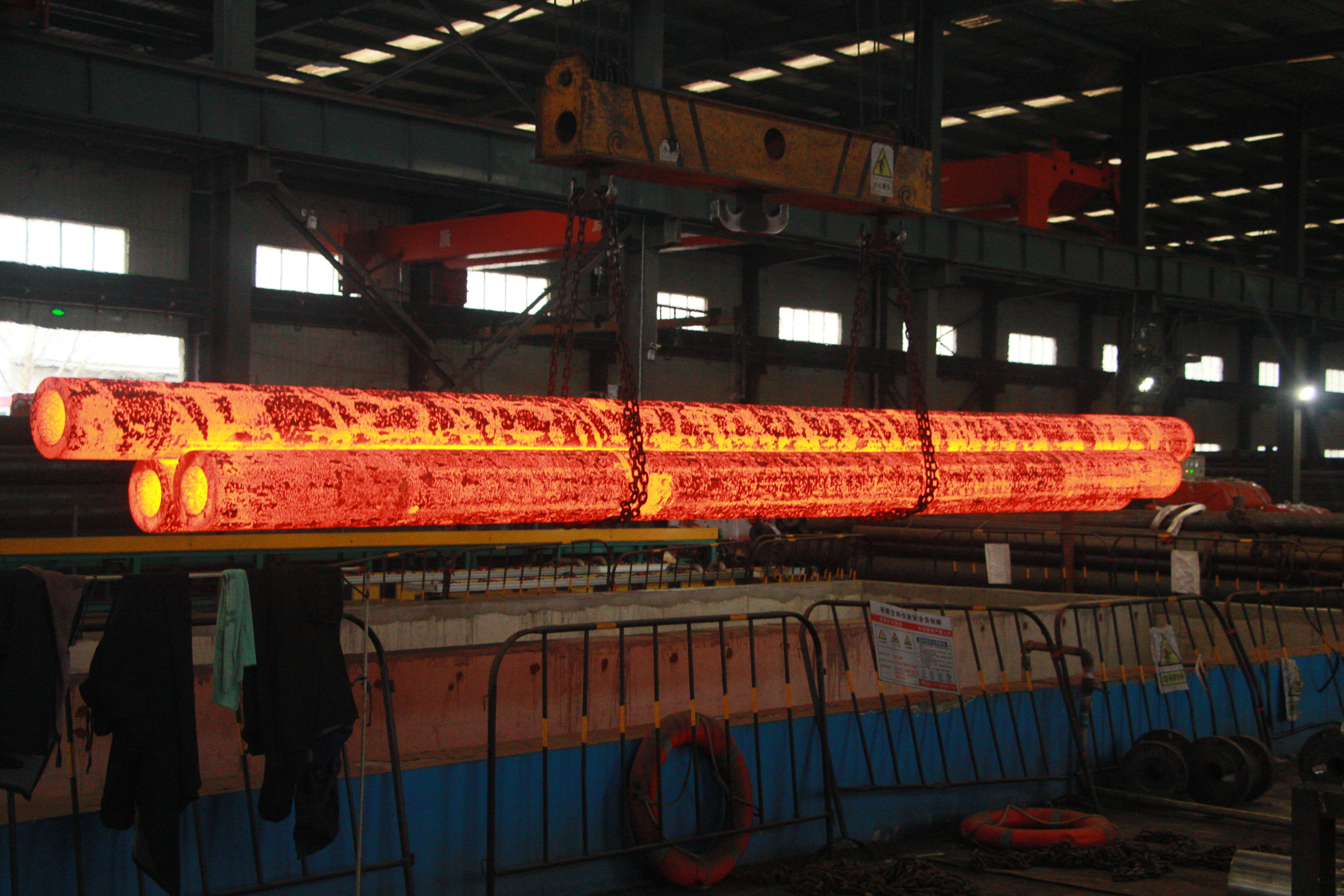
Hot-rolled stock leaves the line before cold drawing, honing and heat treatment. Traceability from this stage to the finished barrel is what allows a buyer to audit a material claim.
Pressure Classes and Standards: What They Do and Do Not Prove
Pressure class is the first number most buyers ask about, and it is also the most frequently misread. ISO 6022:2006 establishes mounting dimensions for single-rod hydraulic cylinders intended for 25 MPa (250 bar) service, with interchangeability as the objective. Heavy-duty cylinders following that standard are designed for a nominal 25 MPa (250 bar), with typical maximum pressures up to 320 bar. ISO 6020-1:2007 does the equivalent job for metric medium-series cylinders at 16 MPa (160 bar).
Those standards define dimensions and interchangeability. They do not certify durability, leakage performance, duty cycle or seal life — a limitation that applies to any dimensional standard and should be stated plainly in a technical review. Application-specific documents sit on top of that. ISO 23778:2022, for example, applies to hydraulic cylinders that form part of the load-carrying structure of cranes, which is a narrower scope than “heavy duty” in general.
Tuoda Machinery builds above the 25 MPa baseline. Its high-pressure hydraulic cylinder range covers 31.5 to 63 MPa for equipment such as hydraulic excavators, crushers, four-column hydraulic presses, marine steering gear and anchor winches. Its ultra-high-pressure range exceeds 63 MPa and is used in specialized equipment including high-pressure water jet cutting machines, artillery recoil systems and material pressure-testing apparatus.
| Reference | What it defines | Stated pressure |
|---|---|---|
| ISO 6020-1:2007 | Metric mounting dimensions, medium series | 16 MPa / 160 bar |
| ISO 6022:2006 | Mounting dimensions, single-rod, 25 MPa series | 25 MPa / 250 bar |
| Heavy-duty cylinders following ISO 6022 | Design basis for the 25 MPa series | Nominal 25 MPa, typical max up to 320 bar |
| Tuoda high-pressure cylinder range | Product range for heavy-duty equipment | 31.5 – 63 MPa |
| Tuoda ultra-high-pressure range | Specialized equipment applications | Above 63 MPa |
Note: ISO standards listed here define mounting dimensions and interchangeability. They are not evidence of a supplier's durability, leakage performance, duty cycle or seal life, and a pressure class should not be substituted across series without a dimensional check.
From Pipe to Finished Heavy Duty Cylinder: The Build Sequence
Understanding the sequence tells a buyer where to attach specifications and where to expect verification evidence. The flow below reflects Tuoda Machinery's custom cylinder process.
- Application analysis. The working load, stroke, cycle pattern, mounting arrangement and environment are defined first. This is where a standard cylinder is separated from a heavy duty hydraulic cylinder built for a specific machine.
- Drawing verification. Bore, rod diameter, stroke, wall thickness, mounting geometry and port positions are checked against the application. For replacement work — for example converting a hydraulic cylinder from single acting to double acting, or replacing a standard cylinder with a heavy duty unit — the mounting dimensions are confirmed separately from the pressure class.
- Material selection. Pipe grade and heat-treatment condition are chosen from the available range, including ST52, S355, E355, C45, SAE1045 and 42CrMo4.
- Pipe processing and honing. The barrel is bored and precision honed, then surface treated. Deep-hole machining capability is supported internally by T2120, T2125 and T2135 deep hole drilling and boring machines, which handle through-holes, blind holes and stepped holes with internal or external chip evacuation.
- Cylinder manufacturing. Assembly uses metal-to-metal sealing, high-performance polyurethane seals, forged valve bodies, thick-walled seamless steel pipe tubing and overpressure protection devices.
- Inspection and testing. Multiple quality inspections are carried out before the cylinder leaves the factory, supported by pressure testing and auxiliary equipment checks.
- Delivery. Pre-shipment testing is the standard acceptance criterion, with delivery terms of FOB, CIF, CFR, EXW or DDP depending on the buyer's preference.
Where Seamless-Pipe Cylinders Are Used
Double-acting construction dominates hydraulic cylinder demand, accounting for a 70% share in 2024, and most heavy duty applications assume a double-acting heavy duty hydraulic cylinder as the default configuration. The duty profile, not the cylinder family, is what drives pipe selection.
- Construction machinery. A heavy duty hydraulic cylinder for construction machinery sees shock loads and contamination. Excavator boom, arm and bucket cylinders are typical, and a hydraulic cylinder for excavator duty is normally specified with a thick wall and a wear-resistant honed bore.
- Mining equipment. A heavy duty hydraulic cylinder for mining equipment runs long shifts under continuous load, where bore roundness and seal stability determine service interval more than peak pressure does.
- Industrial presses. A heavy duty hydraulic cylinder for industrial presses — including four-column hydraulic presses — converts pressure into a controlled force over a long stroke, making a long stroke heavy duty hydraulic cylinder and a large bore heavy duty hydraulic cylinder the two governing configurations.
- Marine and offshore systems. Marine steering gear and anchor winches rely on pressure containment in a corrosive environment, which places additional weight on surface treatment and material selection.
- Material handling. A hydraulic cylinder for forklift mast and tilt functions operates at high cycle counts with tight mounting envelopes, often requiring a custom mounting heavy duty hydraulic cylinder or a non-standard heavy duty hydraulic cylinder.
- Ultra-high-pressure equipment. Water jet cutting machines, recoil systems and pressure-testing apparatus demand barrels built above 63 MPa, where wall thickness and material cleanliness stop being negotiable.
Seamless vs Welded Pipe Inside a Cylinder Barrel
The comparison below describes construction and what each construction implies for barrel work. It is a material-selection reference, not a performance benchmark; actual capability depends on the finished drawing and the test evidence that accompanies it.
| Attribute | Seamless steel pipe | Welded steel pipe |
|---|---|---|
| How it is formed | Pierced and rolled from a solid billet | Formed from steel strip and joined along a longitudinal seam |
| Longitudinal weld | None | Present, with an adjacent heat-affected zone |
| Wall uniformity around the circumference | A product of the forming route, with no seam feature to control | Seam and heat-affected zone require separate control |
| Suitability for a honed bore | Commonly honed to a fine internal finish for cylinder barrels | Seam quality must be established before honing |
| Documents to request | Material certificate, grade, dimensions, heat treatment, test report | Material certificate, weld inspection record, dimensions, test report |
| Typical cylinder role | Barrel and rod material for high-pressure, high-cycle duty | Barrel material where the drawing and duty permit it |
Selection is ultimately a drawing decision. The same nominal bore can be produced from either construction, and the acceptance criteria — pressure test, bore tolerance, surface finish — decide whether the barrel is fit for the application.
What This Means for Long-Term Supply and Repeat Orders
For a distributor or an OEM buyer, the material question becomes a supply question after the first order. A cylinder that was validated once has to be repeatable on the tenth order, which means the pipe grade, the honing process and the inspection routine must all stay inside the same controlled system.
Tuoda Machinery keeps pipe processing and cylinder manufacturing in one facility, which shortens the loop between a specification change and the material that has to support it. Monthly production capacity is customizable and flexible based on order requirements, and the company accepts both single-piece or small-batch runs and mass production. Customization services cover application, size, bore, stroke, pressure, load, system solution, cylinders and logo printing — the fields that a distributor needs when adapting a catalogue product to a regional market.
For buyers planning a high-load upgrade, an efficiency-driven redesign, or a switch to a custom size heavy duty hydraulic cylinder, the useful question is not only whether the supplier can quote a cylinder. It is whether the supplier controls the pipe that the cylinder is built from, and can show the inspection record that connects the two.
Frequently Asked Questions
Which standards should a seamless steel pipe for a heavy duty hydraulic cylinder barrel meet?
It depends on the target market and the application. Tuoda Machinery produces hot-rolled and cold-drawn pipe in line with ASTM and CE requirements, adhering to specifications including EN10210, EN10305, API 5L, A335, A333 and A106. Where interchangeability matters, ISO 6022:2006 defines mounting dimensions for single-rod cylinders at 25 MPa (250 bar) and ISO 6020-1:2007 covers 16 MPa (160 bar) medium-series cylinders; ISO 23778:2022 applies specifically to cylinders that form part of a crane's load-carrying structure. These standards define dimensions and interchangeability — they are not a certificate of durability, leakage performance or duty cycle.
Can the pipe and the cylinder be customized together, or are they bought from separate suppliers?
They can be handled by one supplier. Tuoda Machinery carries out deep processing of seamless steel pipe — including precision honing, surface treatment and heat treatment — and manufactures custom hydraulic cylinders in the same facility. Customization services cover application, size, bore, stroke, pressure, load, system solution, cylinders and logo printing. The product range spans high-pressure cylinders at 31.5 to 63 MPa and ultra-high-pressure cylinders above 63 MPa, which allows a custom mounting heavy duty hydraulic cylinder or a non-standard heavy duty hydraulic cylinder to be specified against the application rather than adapted from a stock size.
What are the purchasing terms, and what drives the cost of a cylinder?
Tuoda Machinery quotes a minimum order quantity of 1 unit, with delivery terms of FOB, CIF, CFR, EXW or DDP and payment by TT or LC; the acceptance criterion is a pre-shipment test. Cost is driven by material grade, wall thickness, bore and stroke, honing requirement, pressure class and sealing system — which is why a heavy duty cylinder carries a higher initial cost than a standard unit while delivering a lower total cost of ownership over its lifecycle. The lowest-priced quote is not necessarily the cheapest solution.
How can a buyer validate quality before committing to mass production?
Validation starts before production. Drawings are verified against the application, material selection is confirmed, and the quotation is re-confirmed with the buyer before the order is released. Before leaving the factory, cylinders go through multiple quality inspections and pressure testing supported by auxiliary equipment checks. Pre-shipment testing is the stated acceptance criterion, so the buyer receives a test result rather than only a visual inspection report.
How is capacity and lead time planned for repeat or mixed-volume orders?
Monthly production capacity is customizable and flexible based on order requirements, and the facility supports both single-piece or small-batch production and mass production runs. Because pipe processing, heat treatment and cylinder machining sit within the same operation, a change in bore, stroke or material grade is coordinated internally rather than renegotiated with an external tube supplier. Buyers planning a high-load upgrade or a fleet replacement programme can request a sample and a quotation from Tuoda Machinery at olivia@sdtuoda.com or +86 13290268388 to confirm dimensions and timing before scheduling.
Conclusion
A seamless steel pipe is defined by how it is made — pierced from a solid billet, rolled without a longitudinal weld — but its value in heavy duty hydraulic cylinders comes from what that construction allows: uniform wall thickness, a bore that can be honed to a repeatable finish, and a continuous pressure boundary that does not depend on a seam.
For buyers in the decision and execution stages, the practical checklist is short. Confirm the pipe classification and grade against the duty. Fix bore, wall thickness and honing on the drawing rather than on a pipe callout. Check the pressure class against the correct standard, and treat that standard as a dimensional reference rather than a performance guarantee. Then confirm that the supplier can show the inspection and pressure-test record that connects the pipe to the finished cylinder.
Ready to specify the pipe and the cylinder together?
Tuoda Machinery supplies carbon seamless steel tube and custom heavy duty hydraulic cylinders from one facility in Liaocheng, Shandong. Send your bore, stroke, pressure and mounting drawing for a technical review, or request the product catalogue before your next order.
Email: olivia@sdtuoda.com | Tel / WhatsApp: +86 13290268388 | Website: www.sdtdsteel.com
Download the catalogue: Tuoda Machinery product brochure (PDF)
Have Questions or Need More Details?
Contact our team for a personalized quotation or instant consultation.
Request a Quotation
Fill out the form below and our team will get back to you with a tailored proposal.
WhatsApp Direct Chat
Prefer to chat in real-time? Message us on WhatsApp for instant assistance & quick answers.
- Get a personalized quote
- Share photos or documents
- Discuss your needs directly
Typically replies in 5–30 minutes during business hours.