Heavy Duty Hydraulic Cylinders: Choosing Between Piston, Plunger, Telescopic and Rotary Designs
Heavy duty hydraulic cylinders are normally specified against three numbers: bore, rated pressure and stroke. Those numbers decide whether a cylinder can survive the duty, but they do not decide which cylinder to buy. Two units with the same bore and the same rated pressure can behave completely differently on the same machine, because the internal design — piston, plunger, telescopic or rotary — fixes how force is delivered, how the rod is guided, how the seals are loaded, and how much space the cylinder occupies when it is fully retracted.
This guide is written for buyers who have reached the evaluation stage: the application is known, the machine envelope is known, and the next decision is the cylinder architecture that will be released to an RFQ. It compares the four designs on the criteria that actually decide a purchase — load profile, pressure class, material grade, sealing strategy, dimensional envelope and lifecycle cost — and it separates what a standard can prove from what only a drawing and a test report can prove.
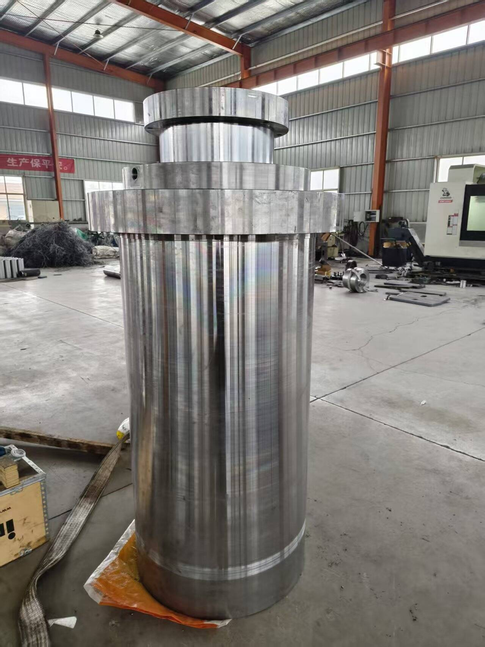
What the Four Heavy Duty Cylinder Designs Actually Do
The clearest way to separate piston, plunger, telescopic and rotary cylinders is by the output they produce, not by the components they contain. Each design solves a different mechanical problem.
Piston cylinder — controlled force in both directions
A piston-type heavy duty hydraulic cylinder carries a piston on the rod inside a honed barrel, with hydraulic oil on both sides of the piston. It is double-acting: pressure on the cap side extends the rod, pressure on the rod side retracts it. Force is available in both directions, position can be held and controlled in both directions, and the rod is guided by a rod bearing and a rod seal in the gland. Sealing performance depends on the piston seal, the rod seal and the internal surface finish of the barrel. This architecture suits machines that must push and pull under control — excavator boom and arm functions, industrial press rams, and lifting equipment that has to hold a load.
Plunger cylinder — high push force in one direction
A plunger cylinder uses a solid or thick-walled ram instead of a piston. Oil acts on one face only, so the cylinder is single-acting; return stroke comes from gravity, a spring, or an external load. The ram works mainly in compression, the construction is simple, and there are fewer sealing interfaces than in a piston design. The trade-off is directional: a plunger cylinder cannot pull. It fits applications where a large push force is needed in one direction over a long stroke and where retraction is handled by the machine itself.
Telescopic cylinder — long stroke inside a short envelope
A telescopic, or multi-stage, cylinder nests two or more barrel sections inside one another and extends them in sequence or together. Its advantage is geometric rather than hydraulic: it delivers a long working stroke from a short retracted length. That makes it the practical answer where installation space is fixed — tipping trailers, lifting platforms, and machine structures that cannot accommodate a single long barrel. The cost of that geometry is more sealing interfaces, more stages to guide, and a maintenance profile that has to be planned rather than assumed.
Rotary / oscillating cylinder — torque over a limited arc
A rotary or oscillating cylinder converts hydraulic pressure into limited-angle rotation rather than linear travel, typically through a helical spline, a rack-and-pinion mechanism or a vane. The output is torque across a defined arc, not a stroke. It is used for steering, indexing, clamping and tilting functions. A rotary cylinder is not a substitute for a linear cylinder; it is a different output, and specifying one where the machine needs linear thrust will not work regardless of bore size.
Why the Type Decision Outranks the Datasheet
Cylinder selection fails most often when the load profile is treated as a single force value. Real duty includes direction, shock, holding time, side loading, cycle count and the maintenance window the machine can tolerate. Those factors do not appear on a generic specification sheet, but they decide which of the four designs is viable.
- Force direction. A machine that must pull as well as push rules out a single-acting plunger design unless the return load exists mechanically.
- Envelope. A fixed installation length can eliminate a single-stage piston cylinder before the pressure rating is even discussed.
- Guiding and buckling. Long strokes with side load put the rod in bending; the guiding arrangement, not the bore, becomes the limiting factor.
- Seal exposure. Contamination, temperature and corrosion attack the rod seal first, and a multi-stage telescopic cylinder exposes more seals than a single-stage piston cylinder.
- Serviceability. The design that is easiest to reseal in place may be worth more than the design with the lowest purchase price.
In practice, the architecture decision should be closed before bore and pressure are fixed, because changing architecture later changes the mounting, the rod-end interface and often the whole machine envelope.
Industry Background: Why Heavy Duty Cylinder Selection Has Become More Technical
The global hydraulic cylinder market was valued at USD 17.34 billion in 2025 and is projected to reach USD 18.11 billion in 2026, according to Fortune Business Insights. The same source reports that Asia Pacific held a 38.40% share of that market in 2025. Grand View Research reports that double-acting cylinders accounted for a 70% share in 2024. Two conclusions follow for buyers: the double-acting piston architecture is the market default, and competitive differentiation between suppliers therefore sits in design detail, material grade, sealing and testing rather than in the choice of double-acting versus single-acting alone.
Standards give buyers a partial safety net, and it is important to read them for exactly what they cover. ISO 6022:2006 establishes mounting dimensions for single-rod hydraulic cylinders used at 25 MPa (250 bar), as required for interchangeability. ISO 6020-1:2007 does the same for medium-series cylinders at 16 MPa (160 bar). ISO 23778:2022 applies specifically to hydraulic cylinders that form part of the load-carrying structure of cranes. None of these documents certifies durability, leakage performance, seal life or supplier capability — they define dimensions and pressure classes. A supplier who presents an ISO 6022 mounting dimension as evidence of heavy duty performance is reading the standard for more than it states.
The same caution applies to commercial web data. Public manufacturer pages can report headline capability — one manufacturer describes heavy-duty welded cylinders rated to 3,000 PSI with bore sizes up to 18 inches — but those figures are company-reported, use different rating conditions and cannot be treated as a validated cross-company benchmark. Use such claims as a lead-generation signal, then request drawings, pressure-test reports and production evidence.
How Tuoda Machinery Builds Each Architecture
Shandong Tuoda Machinery Equipment Manufacturing Co., Ltd. (Tuoda Machinery) is a manufacturer based in Liaocheng, Shandong, China, producing seamless steel pipe, round bar, pressure cylinders and custom hydraulic cylinders. The company operates a 30,000 m² facility with 150 employees and an annual output of 1,200 units, and exports approximately 70% of its output to the EU, Asia and South America.
The custom cylinder range is organised by pressure class. High-pressure hydraulic cylinders cover 31.5 – 63 MPa and are built for equipment such as hydraulic excavators, crushers, four-column hydraulic presses, marine steering gear and anchor winches. Ultra-high-pressure hydraulic cylinders cover pressures above 63 MPa and are built for specialised equipment including high-pressure water-jet cutting machines, artillery recoil systems and material pressure-testing apparatus.
Material grade is selected against the load and the machining route rather than against availability alone. Tuoda builds custom heavy duty cylinders in ST52, S355, E355, C45, SAE1045 and 42CrMo4. Barrel and structural sections are typically drawn from the ST52, S355 and E355 grades, while C45, SAE1045 and 42CrMo4 are applied where rod strength or high-stress sections require a different balance of hardness and toughness.
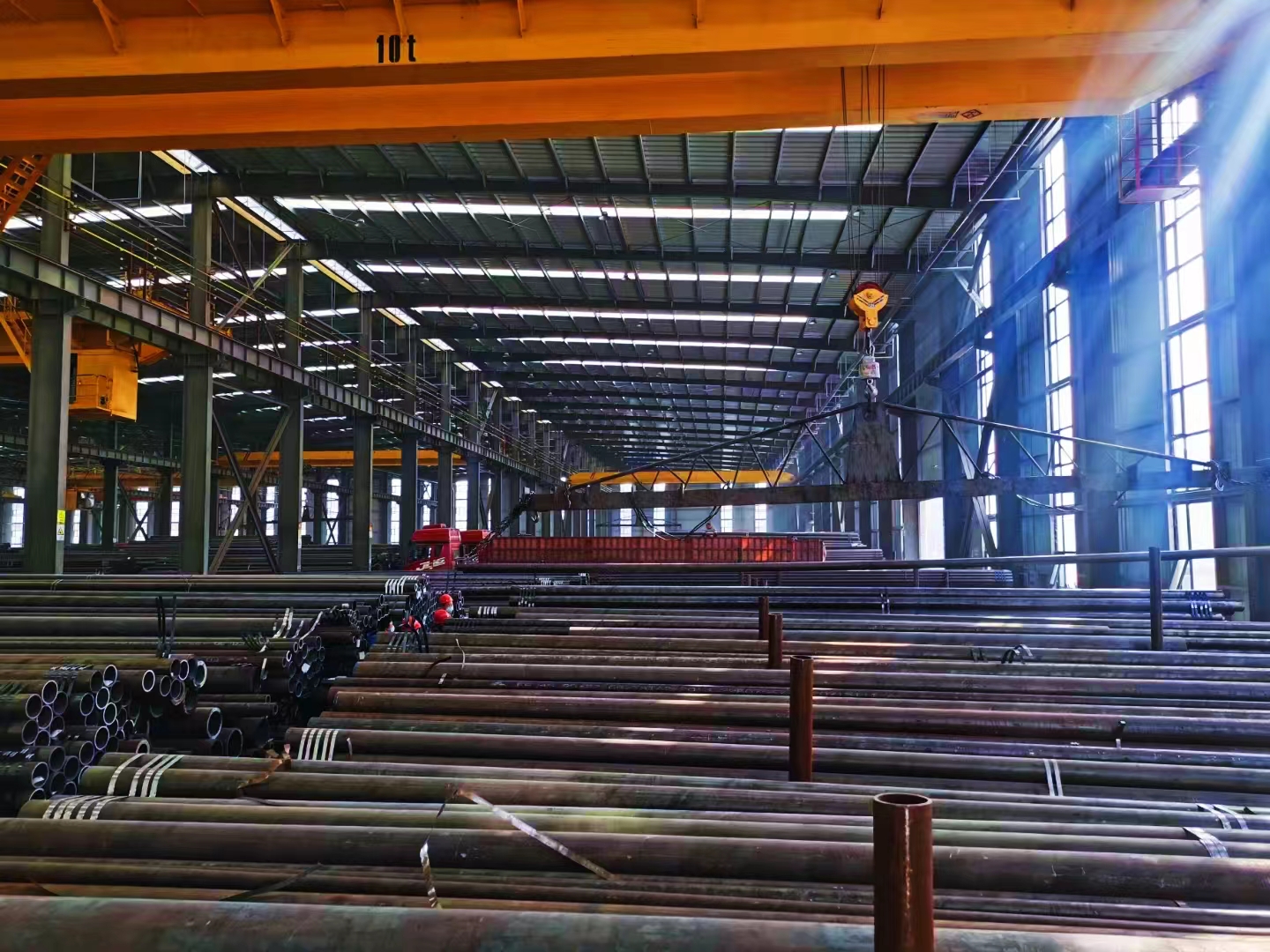
The sealing and internal design package is where heavy duty performance is actually created. Tuoda uses metal-to-metal sealing, high-performance polyurethane seals, forged valve bodies, thick-walled seamless steel pipe tubing and overpressure protection devices. Barrel bore quality is controlled in-house: deep-hole drilling and boring machines from the T2120, T2125 and T2135 series, together with honing and heat treatment, allow the internal surface finish and roundness that seal life depends on.
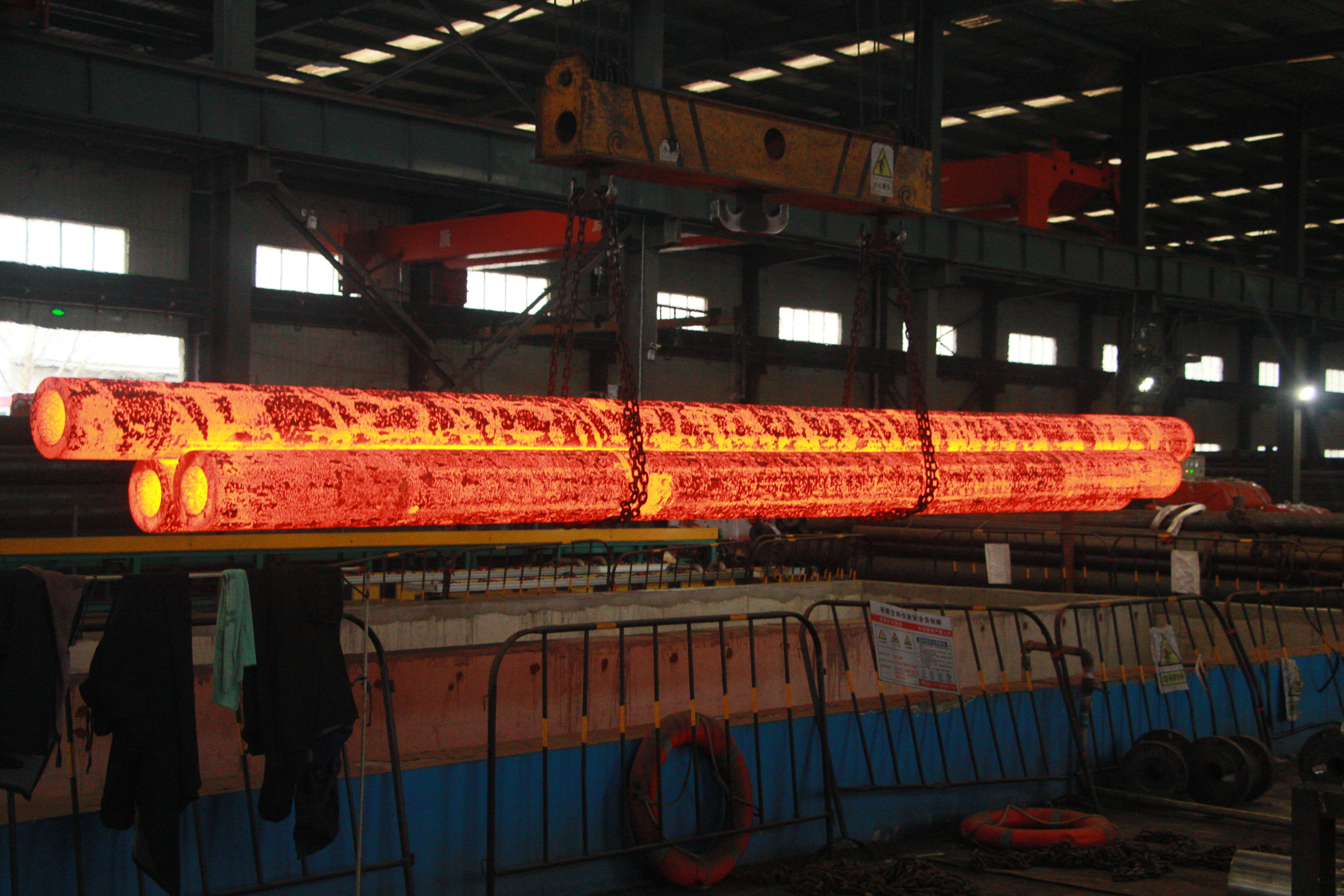
Quality control is pressure testing, and the commercial entry point is deliberately low: the minimum order quantity is 1 unit, and lead time is 45 – 60 days. Single-piece and small-batch runs sit alongside volume production, which matters at the evaluation stage when a buyer needs one cylinder to validate a design before committing a machine programme.
Matching the Design to the Load Profile
When a piston cylinder is the right answer
Choose a double-acting piston cylinder when the machine needs controlled force in both directions, when position must be held under load, and when shock or reversing loads are present. This is the default for excavator and construction machinery functions, industrial presses and lifting equipment. The design also gives the widest freedom in mounting and rod-end configuration, because the rod can be loaded in tension as well as compression. Its limitation is the envelope: a long stroke demands a long barrel, and the rod must be guided against buckling.
When a plunger cylinder is the right answer
Choose a plunger design when force is required in one direction only, when the return stroke can be produced by gravity or an external load, and when simplicity and robustness matter more than reversibility. The reduced number of sealing interfaces is an advantage in dirty or high-cycle environments, but the buyer must accept that the machine, not the cylinder, provides the retraction.
When a telescopic cylinder is the right answer
Choose a telescopic design when the working stroke is long but the retracted length is constrained by the machine. Tipping trailers, lifting platforms and compact lifting structures are typical. Two boundaries should be stated at quotation: the stage sequence determines how force varies through the stroke, and the additional sealing interfaces raise the importance of rod and barrel protection.
When a rotary cylinder is the right answer
Choose a rotary or oscillating design when the output required is torque through a defined angle — steering, indexing, clamping or tilting. It cannot be compared with the other three on stroke, because it does not produce a stroke. Comparing a rotary actuator with a piston cylinder on linear force is a specification error, not a cost decision.
Step-by-Step: Specifying a Heavy Duty Cylinder Before the RFQ
- Define the load profile. Record force direction, magnitude, duty cycle, shock loading, holding time and any side load on the rod. This single step eliminates at least one of the four architectures in most applications.
- Fix the stroke and the retracted envelope. Measure the installed space, not the catalogue space. If the retracted length is constrained while the stroke is long, evaluate a telescopic design before reducing stroke.
- Select the pressure class. Decide whether the application sits in the 31.5 – 63 MPa high-pressure band or above 63 MPa. Ultra-high-pressure builds require forged valve bodies and overpressure protection, so the class decision changes the component set, not only the wall thickness.
- Choose the material grade against the load. ST52, S355 and E355 for barrel and structural sections; C45, SAE1045 or 42CrMo4 where rod strength or high-stress geometry governs. Material grade should follow the stress calculation, not the other way round.
- Define mounting, ports, cushioning and rod-end interface. Mounting dimensions must be specified separately from the pressure class — the two are not interchangeable, and a replacement cylinder that matches bore but not mounting will not fit.
- Define sealing and environmental protection. State contamination exposure, corrosion exposure, temperature range and whether the cylinder operates in a wash-down or marine atmosphere. The seal package and rod coating follow from these answers.
- Verify before shipment. Require drawings, pressure testing records and a pre-shipment acceptance inspection. Commercial terms — Incoterms and payment method — are fixed at quotation stage so that they are part of the same approved document as the technical specification.
Use Cases: What Type Selection Looks Like in Service
A reference installation in Vietnam shows why the design and sealing package decide the outcome more than the purchase price. A heavy machinery OEM used product 3558 in a straightening machine application. The installation consisted of one unit. Over a project duration exceeding ten years, the cylinder achieved stable operation, energy savings and reduced maintenance costs, with zero major failures. The reported highlights were stability under extreme conditions, long service life, low maintenance and cost reduction.
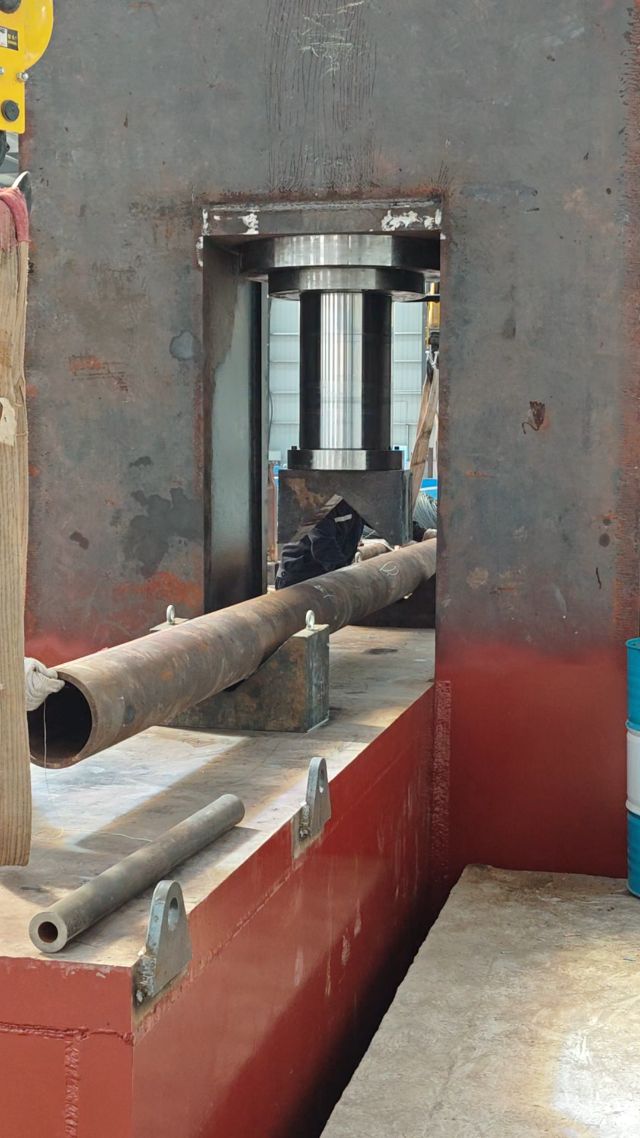
That result is worth reading correctly. A straightening machine loads the cylinder in a repeating controlled cycle, and the reported energy saving and reduced maintenance follow from seal integrity and bore quality rather than from cylinder type alone. The lesson for buyers is that a lower first price buys a shorter seal life, and the cost of the first reseal usually exceeds the initial saving.
The same reasoning maps onto broader applications. Construction machinery — excavator boom, arm and bucket circuits — needs double-acting control with shock resistance. Mining equipment needs the same control plus wear resistance on the rod and protection against contamination. Industrial presses require high force with accurate holding, which places the emphasis on the pressure class and on overpressure protection. Forklift mast and tilt functions require compact, reliable double-acting cylinders where the envelope, not the bore, is the constraint.
Comparison Table: Piston vs. Plunger vs. Telescopic vs. Rotary
| Design | Actuation | Force output | Stroke vs. retracted length | Sealing and guiding load | Best-fit load profile | Main limitation |
|---|---|---|---|---|---|---|
| Piston (double-acting) | Oil on both piston faces | Push and pull, controlled in both directions | Long stroke requires long barrel | Piston seal plus rod seal; rod guided in gland | Reversing, holding and shock loads; presses, excavators, lifting equipment | Envelope length; rod buckling on long strokes |
| Plunger (single-acting) | Oil on one ram face | Push only | Long stroke, simple barrel | Fewer sealing interfaces; ram loaded in compression | One-direction high push force with mechanical return | Cannot pull; return depends on the machine |
| Telescopic (multi-stage) | Oil across nested stages | Push (sequence-dependent) | Long stroke from a short retracted length | Multiple sealing interfaces; several stages to guide | Space-constrained long-stroke lifting | More seals to maintain; stage sequencing |
| Rotary / oscillating | Pressure converted to torque | Torque over a limited arc | Not a linear stroke | Rotary sealing at shaft and vane or spline | Steering, indexing, clamping, tilting | Angle-limited; not a linear thrust device |
Pressure class reference
| Class | Range | Build implications | Typical equipment |
|---|---|---|---|
| High-pressure | 31.5 – 63 MPa | Thick-walled seamless tube, high-performance polyurethane seals, metal-to-metal sealing | Hydraulic excavators, crushers, four-column hydraulic presses, marine steering gear, anchor winches |
| Ultra-high-pressure | Above 63 MPa | Forged valve bodies, overpressure protection devices, upgraded seal package | High-pressure water-jet cutting machines, artillery recoil systems, material pressure-testing apparatus |
Frequently Asked Questions
Which standards apply to heavy duty hydraulic cylinders?
Three published ISO standards are commonly referenced, and each has a narrow scope. ISO 6022:2006 sets mounting dimensions for single-rod cylinders at 25 MPa (250 bar) for interchangeability. ISO 6020-1:2007 sets metric mounting dimensions for medium-series cylinders at 16 MPa (160 bar). ISO 23778:2022 applies to cylinders that form part of the load-carrying structure of cranes. None of them certifies durability, seal life or leakage performance, so compliance with a mounting standard should be treated as a dimensional baseline, not as proof of heavy duty capability.
Can Tuoda Machinery build a custom heavy duty cylinder outside catalogue sizes?
Tuoda Machinery customises on application, size, bore, stroke, pressure and load, and also builds system solutions and cylinders with customer logo printing. Material grades available include ST52, S355, E355, C45, SAE1045 and 42CrMo4, across the high-pressure 31.5 – 63 MPa band and the ultra-high-pressure range above 63 MPa. The final architecture — piston, plunger, telescopic or rotary — is confirmed against the load profile and the approved drawing during quotation, because the architecture decision changes the mounting and the seal package.
Why does a heavy duty cylinder cost more upfront but less over its lifecycle?
The price difference sits in the barrel bore quality, the seal package, the material grade and the pressure testing — the four items that determine how long the cylinder runs before its first reseal. In the Vietnam straightening machine installation, one unit operated for more than ten years with stable performance, energy savings, reduced maintenance cost and zero major failures. Buyers evaluating on lifecycle cost should compare the cost of the first reseal and the downtime it causes against the initial price difference, not the two purchase prices alone.
What is the minimum order quantity for a custom cylinder?
The minimum order quantity is 1 unit. Tuoda Machinery runs single-piece and small-batch production alongside volume orders, which lets a buyer validate one cylinder on a real machine before releasing a larger programme. A single unit is the normal route for confirming sealing behaviour, mounting fit and rod-end geometry under actual duty.
How long is lead time, and how is quality verified before shipment?
Lead time is 45 – 60 days. Quality control is pressure testing, and a pre-shipment acceptance inspection can be arranged so that the buyer reviews the tested unit against the approved drawing before dispatch. To start an evaluation, send the load profile, stroke, retracted envelope, pressure class and mounting details for a quotation or a sample discussion. Tuoda Machinery can be reached at Olivia@sdtuoda.com or +86 13290268388 (WhatsApp +8613290268388), and the company catalogue is available for download below.
Conclusion: Decide the Architecture First, Then the Numbers
Piston, plunger, telescopic and rotary cylinders are not four grades of the same product. They are four different outputs, and the correct one follows from the load profile, the installation envelope and the maintenance window the machine can accept. Once the architecture is fixed, bore, pressure class, material grade and sealing package can be specified against evidence: ISO pressure-class baselines for dimensions, a documented material grade such as ST52 or 42CrMo4 for the stress case, and a pressure test record for the finished cylinder.
The evaluation question that remains is not which design is better, but which supplier can show the drawing, the material certificate and the test result behind the design. That is the difference between a cylinder that is replaced on schedule and one that is replaced on failure.
Request a Heavy Duty Cylinder Quotation or Sample
Send your load profile, stroke, retracted envelope, pressure class and mounting drawing to Tuoda Machinery. Minimum order quantity is 1 unit, lead time is 45 – 60 days, and every cylinder is pressure tested before shipment.
Email: olivia@sdtuoda.com | Tel / WhatsApp: +86 13290268388 | Website: www.sdtdsteel.com
Download the full product catalogue: Tuoda Machinery Catalogue (PDF)
Have Questions or Need More Details?
Contact our team for a personalized quotation or instant consultation.
Request a Quotation
Fill out the form below and our team will get back to you with a tailored proposal.
WhatsApp Direct Chat
Prefer to chat in real-time? Message us on WhatsApp for instant assistance & quick answers.
- Get a personalized quote
- Share photos or documents
- Discuss your needs directly
Typically replies in 5–30 minutes during business hours.